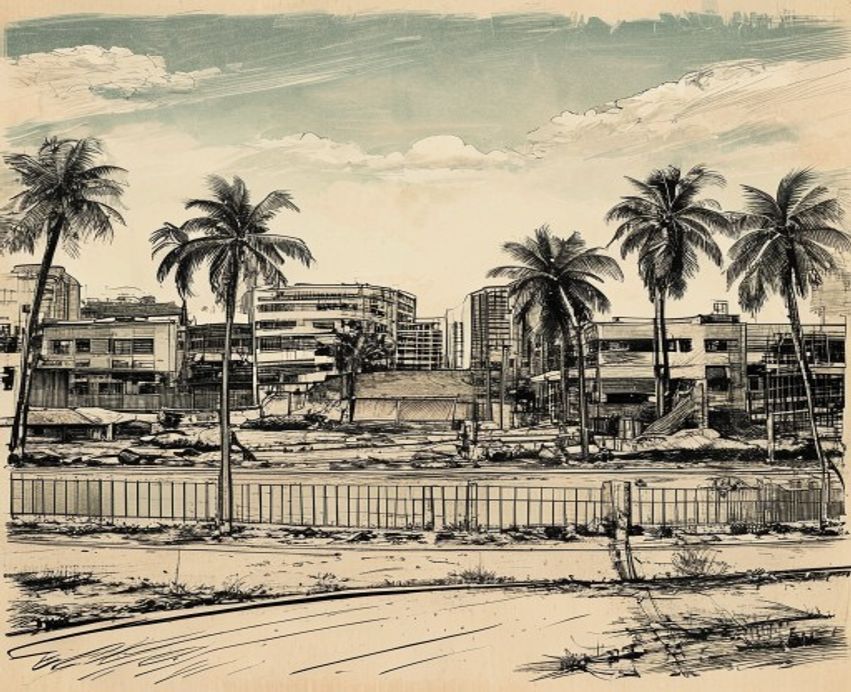
A development project that sat dormant for years in Miami's Little Haiti neighborhood is back — and significantly reimagined. Technology investor Bob Zangrillo and Plaza Equity Partners have announced the revival of the Magic City Innovation District, now recast as a $3 billion campus targeting artificial intelligence companies, financial firms, and innovation-sector tenants.
The master plan, which spans 7.8 million square feet, represents one of the most ambitious single-site development proposals in Miami-Dade's recent history. The mixed-use vision calls for more than 2,600 residential units, a dedicated AI-focused office campus anchored by Zangrillo's own firm Dragon Global, a hotel, retail space, and — notably for commuters — a planned commuter rail station integrated into the project.
The announcement, made in late June 2026, signals a dramatic pivot from the project's earlier identity. Magic City was originally conceived as a broad creative and innovation district but stalled amid community opposition, legal challenges, and shifting market conditions. Its return under an explicit artificial intelligence banner reflects the tech-sector land rush that has reshaped Miami's commercial real estate ambitions since the pandemic-era influx of venture capital and finance firms.
The first phase of construction is expected to center on a 25-story apartment tower, giving the sprawling plan a concrete near-term milestone. Developers have not yet disclosed a groundbreaking date, but the phased approach suggests an effort to demonstrate momentum while the larger entitlement and financing picture comes together.
For Little Haiti — a historically Haitian-American neighborhood that has faced intense gentrification pressure as Miami's urban core expands northward — the return of Magic City carries both promise and anxiety. The development team sought to address community concerns by reaffirming a $31 million commitment to the Little Haiti Revitalization Trust, a fund earmarked for affordable housing production and broader neighborhood investment. That pledge, first negotiated during the project's earlier iteration, had been a central demand from community advocates who argued that large-scale development in the area must produce tangible benefits for longtime residents.
Whether $31 million proves sufficient to offset displacement pressures generated by a $3 billion, multi-tower development remains a core question for neighborhood organizations and city officials alike. Little Haiti has seen rents climb sharply over the past several years, and advocates have consistently argued that the community benefits package attached to Magic City falls short of what a project of its scale demands.
The planned commuter rail station, if realized, could offer one of the more tangible public benefits — connecting a neighborhood that has historically had limited rapid-transit access to Miami's broader rail network. Details on which rail line or agency would serve the station were not specified in the announcement.
Miami city and Miami-Dade county officials have not yet publicly commented on the revived proposal's regulatory path forward.
The original reporting on the Magic City Innovation District revival was published by Florida YIMBY.