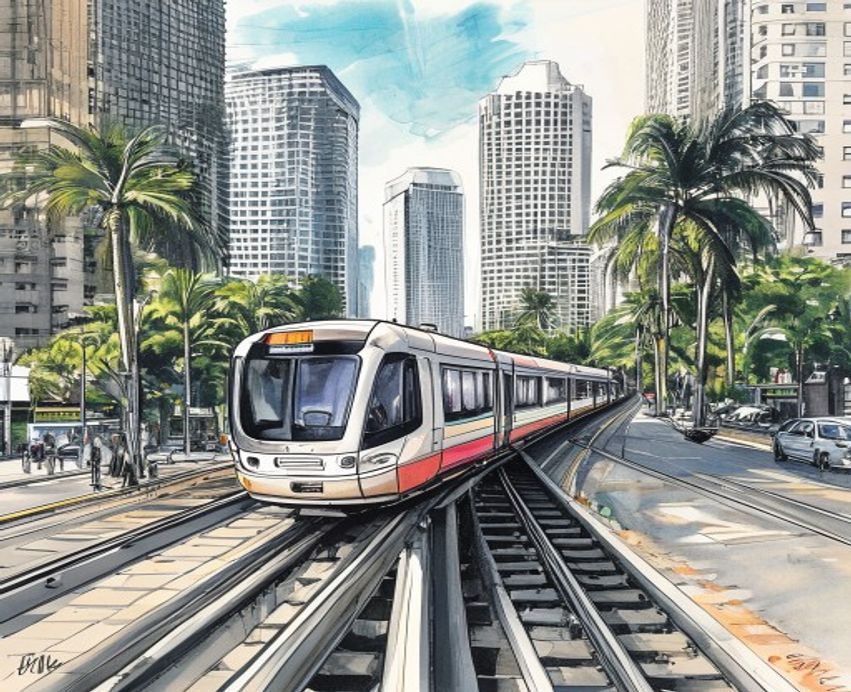
Miami's Metromover carried an average of roughly 25,100 passengers per day during the first quarter of 2026, cementing its standing as the most-used automated people mover in the United States, according to newly released federal transit data.
The American Public Transportation Association's First Quarter 2026 Transit Ridership Report, published May 28, shows the free downtown circulator logged approximately 7,683,800 total rides in 2025 — a throughput that leaves peer systems well behind. The Jacksonville Skyway and the Detroit People Mover, the two closest comparisons among U.S. downtown circulators, trail Miami's numbers by a considerable margin.
The Metromover's elevated loop connects some of Downtown Miami's densest destinations, threading through Brickell, Park West, and the Arts & Entertainment District before circling back through the urban core. Because the system is fare-free, it functions as both a commuter connector and an everyday convenience for residents, office workers, tourists, and event-goers — a broad ridership mix that likely contributes to its consistent headcount.
The strong performance arrives at a consequential moment for the system's future. Miami-Dade County is currently pursuing a $153 million upgrade package aimed at modernizing Metromover infrastructure, while county planners are simultaneously weighing longer-term options that could include replacing the aging system altogether. The ridership figures add weight to arguments for sustained investment: a network moving more than 25,000 people daily is not a peripheral amenity but a core piece of the region's transit backbone.
First opened in 1986 and expanded in the 1990s, the Metromover runs on rubber-tired, driverless vehicles along a roughly 4.4-mile guideway. It operates as a feeder to Metrorail and Tri-Rail connections at Government Center and Brickell stations, amplifying its role beyond simple downtown circulation.
With Downtown Miami continuing to absorb new residential towers, hotel projects, and office development, ridership pressure on the circulator is unlikely to ease. Whether the county's planned upgrades prove sufficient — or whether a more comprehensive overhaul becomes unavoidable — may depend in part on how quickly that growth translates into additional daily boardings.
Ridership figures cited in this report are drawn from the APTA Q1 2026 Transit Ridership Report (via Wikipedia).