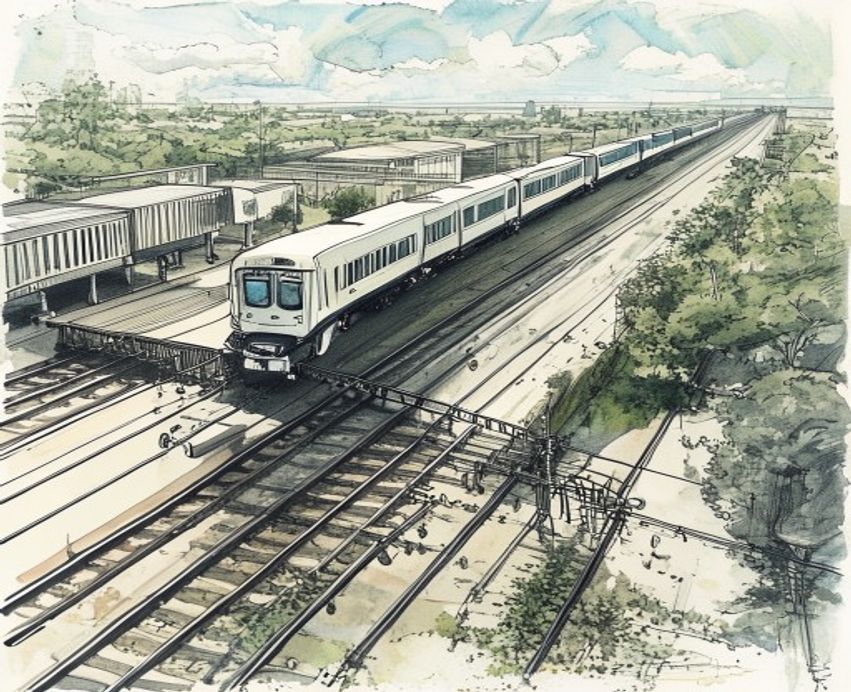
South Florida has been promised a coastal commuter rail line for so long that the dream itself has grown middle-aged. Now, county officials are finally on the verge of signing a deal — and somehow the terms they've agreed to are even shakier than the decades of delay that preceded them.
A draft agreement obtained by WLRN reveals that Miami-Dade County is close to formalizing a taxpayer-funded partnership with Brightline to operate the so-called "Coastal Link," a commuter rail corridor that would connect Miami-Dade, Broward, and Palm Beach counties along existing Florida East Coast Railway (FECR) tracks. On paper, it sounds like the transit breakthrough this gridlocked region has craved. Look under the hood, and it reads more like a liability transfer disguised as a public service.
Start with the money. Brightline would operate and maintain the commuter trains at an estimated cost of $33.9 million annually — in 2026 dollars, a figure explicitly subject to change. The county would pay Brightline an "operations fee" on top of that, and Brightline can suspend service entirely if it decides county funding is insufficient. Meanwhile, the county would be on the hook for constructing new stations, upgrading infrastructure, and — if it wants new train cars — handing Brightline the procurement contract to spend county money as it sees fit. The preliminary deal pegs Miami-Dade's total milestone payments before revenue service even begins at $330 million. All of this flows toward a company whose debt rating has sunk to junk status.
Then there is the more fundamental problem: the tracks don't belong to Brightline. FECR — the freight railroad that actually owns the corridor — sued Brightline last year, alleging it was locked out of negotiations entirely. FECR and Brightline are now in ongoing arbitration over the dispute, yet the draft agreement contemplates beginning the design phase of new commuter stations while that arbitration is still unresolved. That means Miami-Dade could spend public money designing stops that FECR — which has publicly called commuter rail on its corridor "an unviable and unsafe pipe dream" — may later demand be relocated, reduced in number, or scrapped altogether. The parties themselves acknowledge in the draft's language that such changes could jeopardize the county's ability to secure a federal Full-Funding Grant Agreement from the FTA. In other words, the county is prepared to spend design dollars on a foundation that might crumble before a single shovel breaks ground.
The urgency here is real — nobody is arguing South Florida doesn't need this link. Miami-Dade Metrorail logged 14.9 million trips in 2025 and was averaging just 51,600 weekday riders as of Q1 2026, a system straining to serve a county of 2.8 million people where traffic suffocation is a daily civic emergency. The region's population and development pressure aren't going anywhere. Florida is projected to add roughly 306,000 net new residents per year through 2030, and many of them will land in South Florida.
But need does not justify recklessness. The Coastal Link agreement, as drafted, gives Brightline enormous control — over train car procurement, contractor selection, station design, and the unilateral right to suspend service — while saddling taxpayers with construction costs, operating costs, and the design-change risk created by an unresolved freight railroad lawsuit. This isn't a public-private partnership; it's a public-sector rescue operation for a junk-rated private company, dressed up as regional transit progress.
Miami-Dade commissioners owe residents something better before they sign. At minimum: FECR must be at the table with a signed access agreement before any county design dollars move. Brightline's right to suspend service based on its own funding assessment must have hard contractual limits. And the $33.9 million annual operating cost must have a genuine cap, not a market-adjustment escape hatch.
The Coastal Link could genuinely transform how South Florida moves. That's exactly why county leaders shouldn't ink a deal that trades away its leverage before a single train runs.