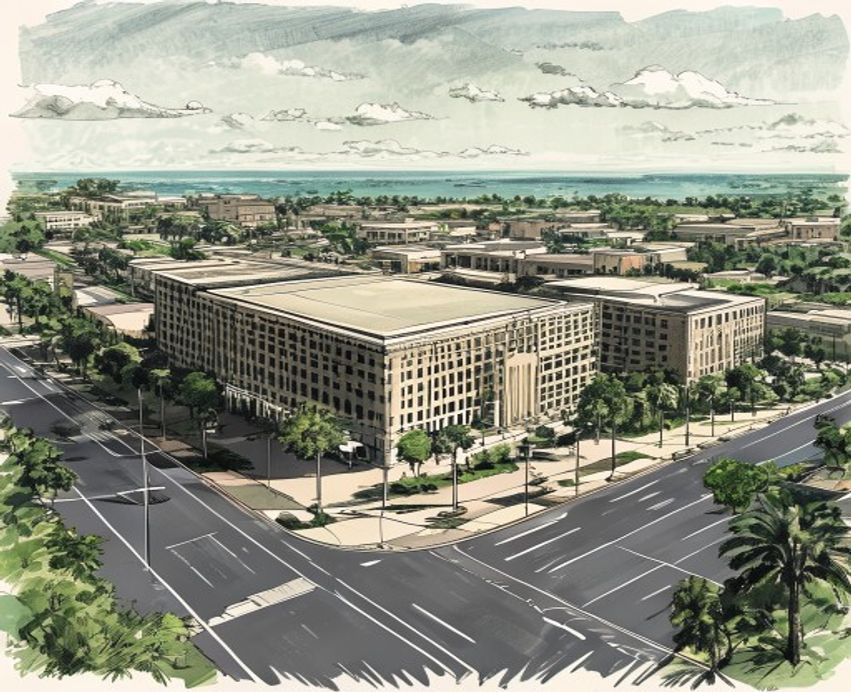
Something genuinely transformative is happening at the faded retail cathedrals of South Florida. Across Miami-Dade, Broward, and Palm Beach counties, developers are tearing down anchor stores and proposing to replace them with something the region has lacked for decades: actual urban neighborhoods. The Real Deal mapped the wave on July 1: more than a half-dozen shopping centers are slated for redevelopments that would add thousands of apartments alongside hotels, offices, and restaurants — a fundamental reshaping of how South Floridians might live.
The numbers are staggering. At Fort Lauderdale's Galleria alone, developer Russell Galbut's GFO Investments has proposed nine 30-story towers containing over 3,000 apartments, a 170-room hotel, and 30 restaurants, all invoking Florida's Live Local Act to bypass local zoning objections. In Doral, Simon Property Group's Miami International Mall is moving forward with an 896-unit apartment project on the old Sears and JCPenney footprints. These aren't boutique infill plays. They are small cities being stitched onto aging asphalt.
The instinct behind all of this is correct. South Florida desperately needs housing density, and converting zombie retail into walkable mixed-use is about as smart a use of land as the region has produced in a generation. The Live Local Act, for all its controversy, is doing real work here. And it's no coincidence that this boom is happening just as Miami-Dade's own commercial real estate market has gone stratospheric — Q2 2026 office leasing jumped nearly 45 percent year-over-year, and average asking rents hit $67 a square foot, up nearly 57 percent from five years ago, according to data from Savills compiled by Commercial Observer. The job base is real. The population pressure is real.
But here is what keeps me up at night about all of this: we are about to drop tens of thousands of car-dependent residents onto corridors that our transit network was never designed to serve at this density — and nobody in a position of power seems to be connecting those two facts.
Miami-Dade's Metrorail logged about 51,600 weekday riders in Q1 2026. For a county of 2.8 million people, that's a rounding error. The system's own structural design tells the story: nearly every station outside downtown was built as a park-and-ride facility, premised on suburban residents driving to the train. The Galleria mall sits well east of Brightline's Fort Lauderdale station with no fixed-rail connection. Miami International Mall in Doral is about as far from a Metrorail station as you can get while still being in Miami-Dade County. If you build 896 apartments in Doral and your tenant base can't take transit to work, you haven't solved a housing problem — you've created a traffic problem.
The one recent data point that should give planners genuine hope — and a concrete blueprint — is what happened on April 4, when over 2,000 fans took Metrorail to Inter Miami's inaugural match at Miami Freedom Park's Nu Stadium. The Miami International Airport Station saw same-day ridership surge more than 150 percent compared to the year prior. Systemwide Metrorail ridership rose more than 16 percent that day compared to the April 2025 average. The lesson is simple: build something people want to reach, put it near a station, and they will ride.
Mall redevelopments are the rare moment when a region gets to do land use planning from scratch on large parcels. The Broward County PREMO light rail concept, which aims to connect Fort Lauderdale-Hollywood International Airport with downtown Fort Lauderdale, is the kind of spine that could knit these new nodes together — but it's still in the planning stages. The Live Local Act fast-tracks the apartments. It does nothing to fast-track the buses or trains.
South Florida's developers have found the land. They've found the capital. What they have not found — and what county commissioners in Miami-Dade and Broward have not demanded — is a genuine commitment to transit-oriented density rather than just density.
Building a neighborhood without a transit plan isn't urbanism. It's just vertical sprawl.